
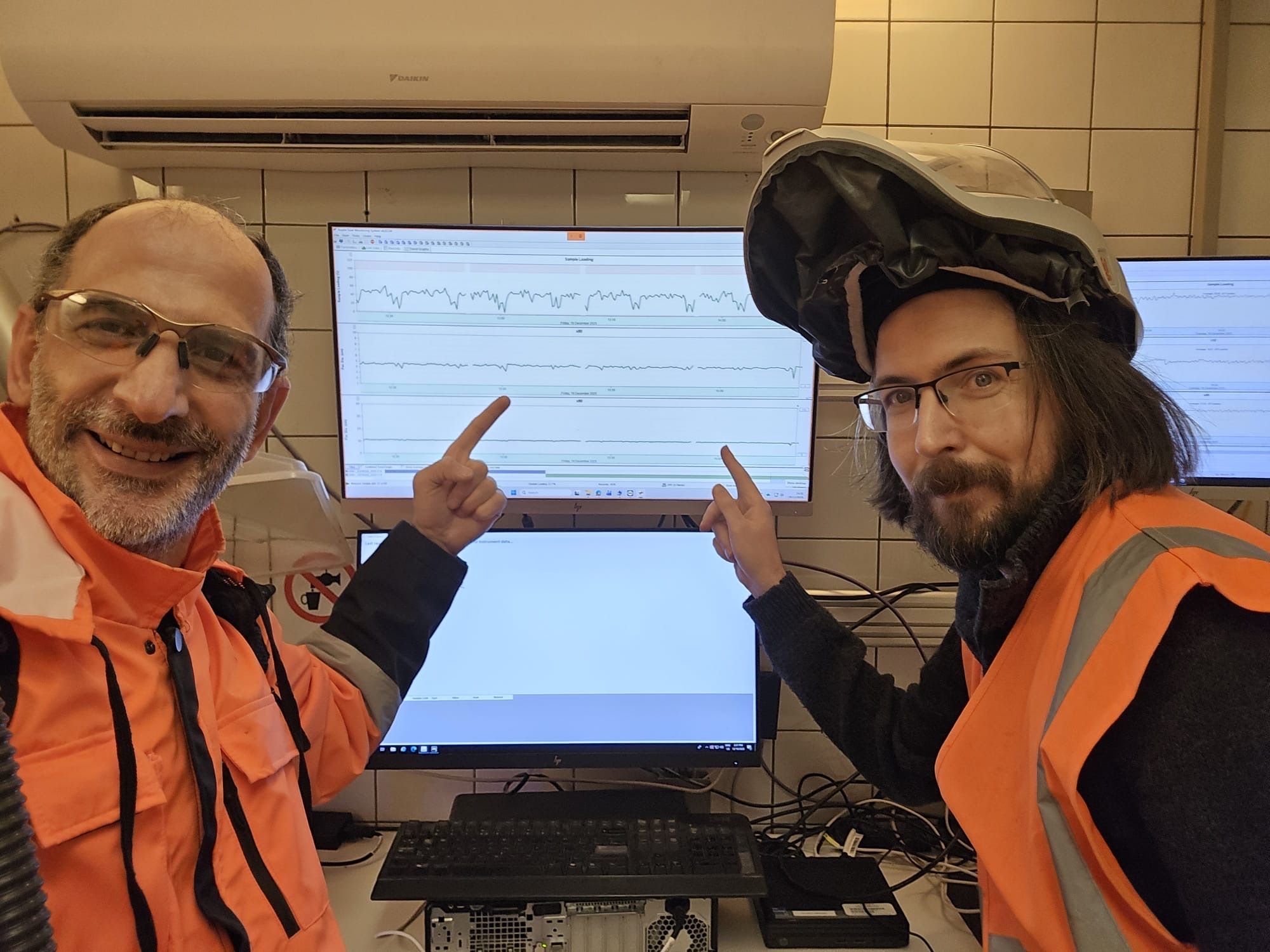
Avoid Overgrinding
Case III. Approaching coarse limit, avoiding overgrinding
In many grinding processes, operators intentionally overgrind material as a safety margin to avoid exceeding the coarse specification limit. Because traditional laboratory measurements are delayed and less reproducible, there is always uncertainty about the true particle size at any given moment. To avoid producing off-spec coarse product, the mill is often operated more conservatively than necessary, leading to excessive energy consumption and reduced process efficiency.
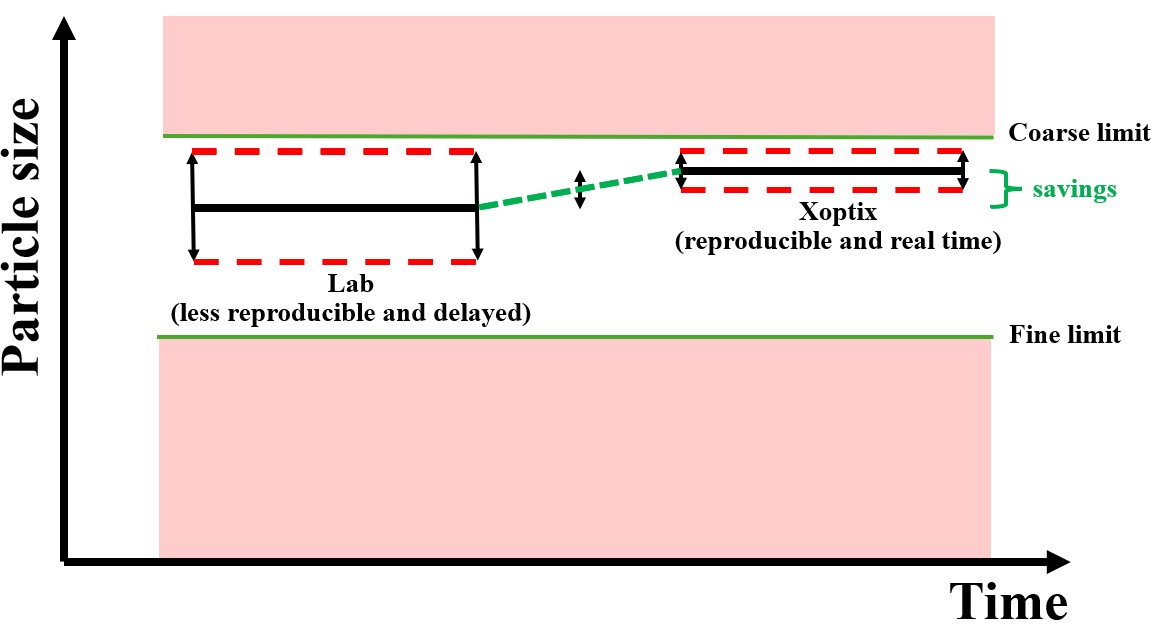
Real-time inline PSD monitoring with Xoptix allows operators to continuously observe the actual particle size distribution with high reproducibility and without laboratory delay. Instead of “driving blind” between infrequent lab measurements, the process can be controlled with immediate feedback. This allows the grinding circuit to safely operate much closer to the coarse specification limit while maintaining consistent product quality.
As process uncertainty is reduced, the production target can be safely shifted closer to the coarse specification limit, improving mill efficiency while consistently maintaining product quality.
By reducing unnecessary overgrinding, significant process benefits can be achieved. Specific power consumption decreases because less energy is wasted producing excessively fine material, while mill throughput can increase as the classifier and grinding circuit operate more efficiently. Even relatively small production increases can generate substantial financial savings in high-capacity industrial plants operating continuously throughout the year.
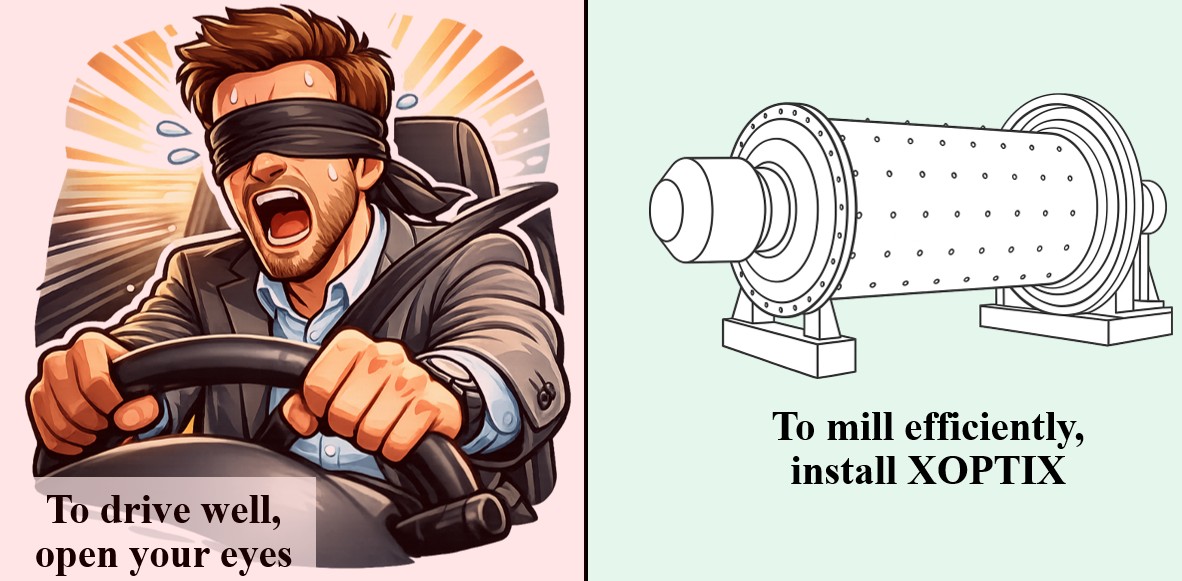
Trying to operate a grinding circuit without real-time PSD feedback is like a blind driver trying to stay in his lane. Looking at the road once every two hours — and only through a rear-view mirror — is not enough to drive efficiently or safely. In the same way, delayed laboratory measurements cannot properly control a dynamic grinding process. Xoptix provides the “eyes” of the mill operation, delivering continuous real-time particle size information that allows the process to stay on target and operate efficiently.
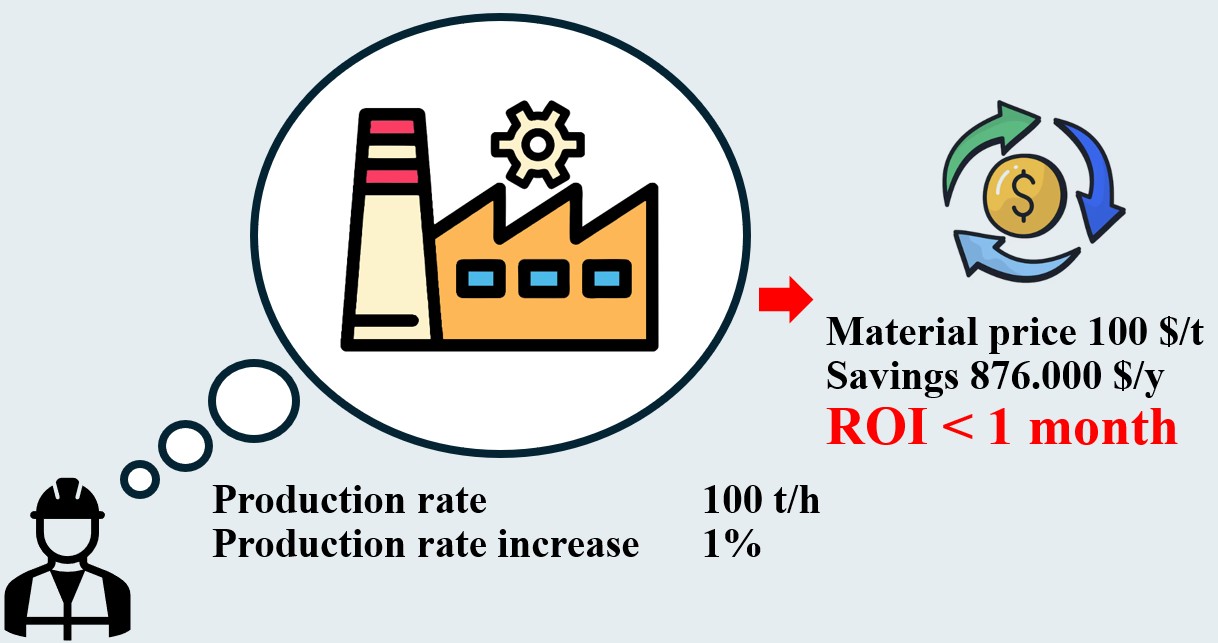
In the ROI example presented, a production increase of only 1% generated estimated annual savings of 876,000 $ with a return on investment of less than one month. Typical benefits for a cement factory are around 3% increased production throughput — a no-brainer when operating a large-scale continuous grinding process.
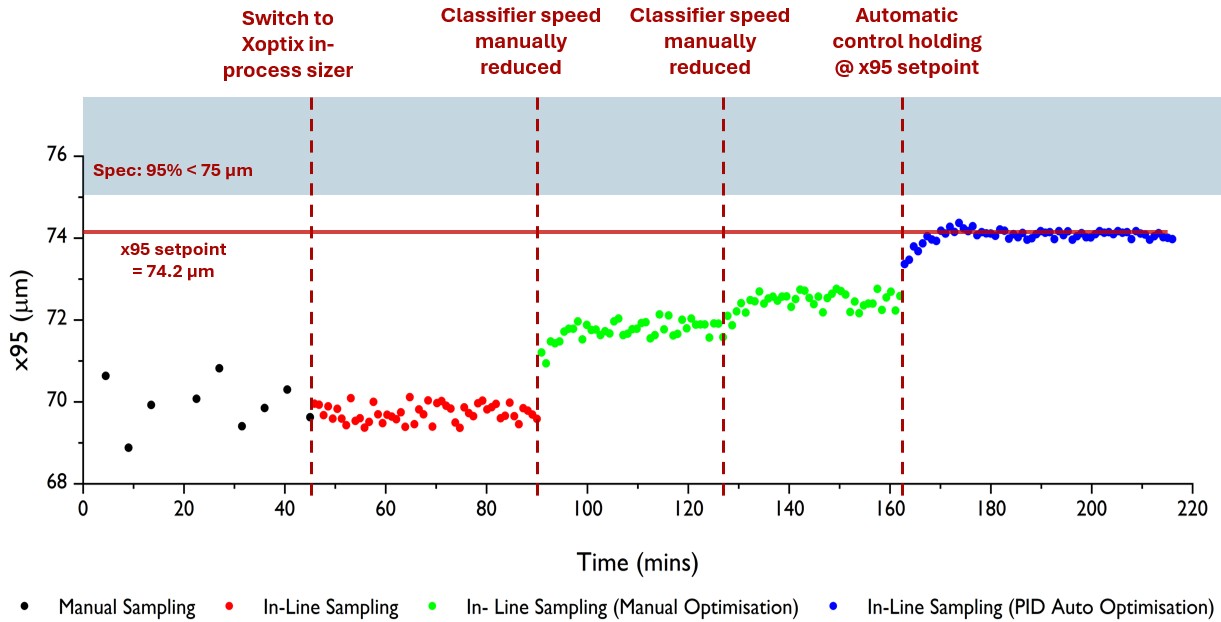
Another industrial example (limestone grinding) demonstrated how switching to Xoptix in-process particle size measurement enabled automatic control close to the specification limit, reducing specific power consumption from 49 to 38 kWh/t while simultaneously increasing production rate by approximately 10%.